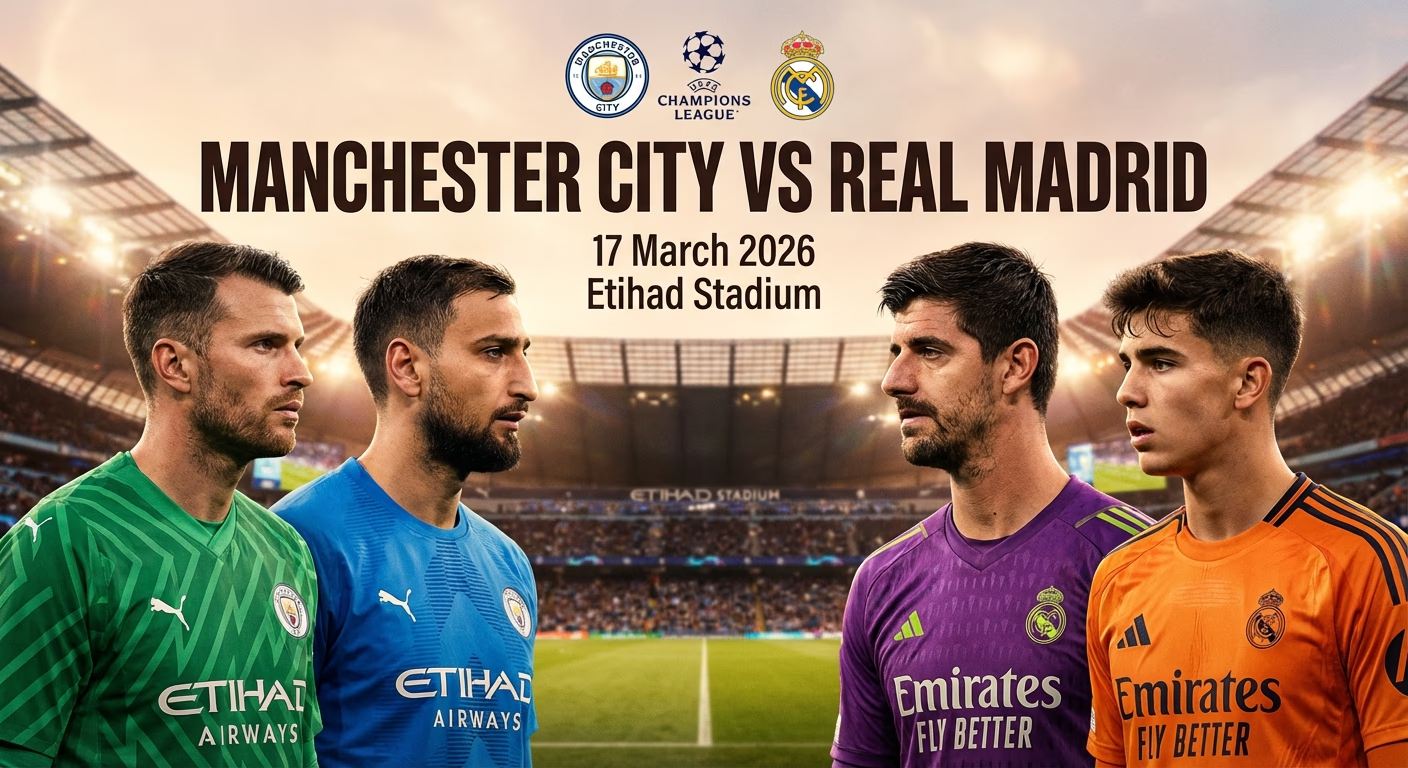



Tuesday night’s Round of 16 showdown at the Etihad felt like the Champions League’s main event: Manchester City welcomed Real Madrid for a tie that would not look out of place in Berlin this June, and the two heavyweights duly delivered before Carlo Ancelotti’s side stole a 2-1 victory. The competition may run on a new Swiss algorithm, but nothing felt more traditional than Pep Guardiola against Ancelotti with the stakes this high, and the tension finally broke only when Madrid closed out the win.
The context is merciless for the hosts. City emerged from the league phase in eighth place on 16 points, riding a WLWLW run that hints at brilliance interrupted by the odd lapse, and the memory of last season's quarter-final exit clearly lingers in this part of Manchester. Guardiola did revert to his 3-2-4-1 shell, Rodri and John Stones stepping into midfield to keep Erling Haaland supplied, yet the champions’ Etihad comfort blanket slipped: after winning three of four home assignments and conceding just three times earlier in the league phase, they were prised open twice by Madrid’s ruthless transition play.
Real Madrid arrive with the aura of 14 European Cups but a form line that reads LWLWL, which is as erratic as Ancelotti gets. Even so, their fifth-best league-phase attack—21 goals in eight matches—translated in Manchester, with Vinicius Junior and Rodrygo converting enough of Madrid’s chances to overturn their middling away record of two wins and two losses. Ancelotti stayed loyal to his 4-3-1-2, Jude Bellingham given license behind the Brazilian duo, and the Italian’s patience with that structure was rewarded as Madrid escaped the Etihad having conceded only once.
Tactically the duel hinges on midfield control. Rodri remains Guardiola’s compass, and Phil Foden’s inside-left roaming still generated pockets, but Madrid’s trio of Federico Valverde, Aurelien Tchouameni, and Eduardo Camavinga smothered the half-spaces that usually fuel City’s fluency. Bernardo Silva oscillated between partnering Rodri deeper and drifting higher to pin Ferland Mendy, yet Madrid’s discipline meant Haaland versus Antonio Rüdiger rarely tilted in City’s favour. The quieter battle between Josko Gvardiol and Vinicius on the left flank ultimately decided much of the tempo: each time Vinicius snuck around the corner, Bellingham arrived and the visitors threatened chaos.
There are quirks on the benches too. Sávio’s late introduction could not tilt the press in City’s favour, while Brahim Diaz once again gave Ancelotti an option to tighten the inside lanes. Neither manager will confess to second-guessing himself, yet their familiar habits were evident: Guardiola sought sterile domination, Ancelotti deployed the rope-a-dope that has broken so many English hearts. This sixth meeting in five seasons again proved that the margins between structure and aura are painfully fine.
This tie also slots into a wider European week. Chelsea face Paris Saint Germain on Wednesday, a clash that casts a long shadow over the Premier League’s continental ambitions, and Liverpool’s latest surge, chronicled after their win over Tottenham, reminds everyone that English clubs still smell opportunity in this revamped format. Madrid now carry a 2-1 advantage back to the Bernabéu, and if Ancelotti safeguards it the balance of power could swing decisively toward Spain.
The night has already told us plenty about whether City’s meticulously engineered machine can repeat the trick that once eluded Roberto Mancini and Manuel Pellegrini—or whether Madrid’s elastic belief bends without breaking. In an age of expanding competitions and algorithmic draws, the sport still comes down to Guardiola, Ancelotti, and 90 minutes (plus stoppage time) of human nerve, and this time the scoreboard read Manchester City 1-2 Real Madrid.