

Wembley remembers
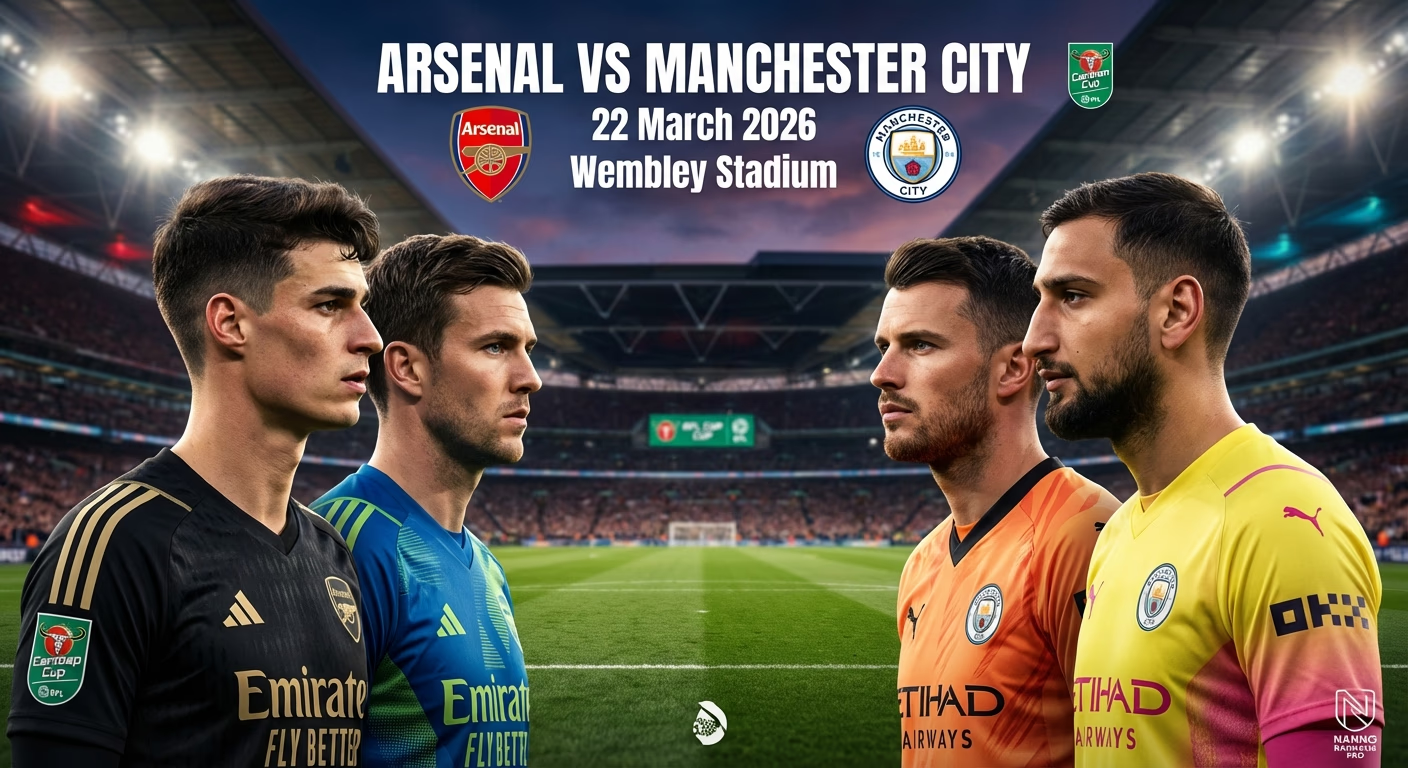
Eight years have passed since Arsenal stepped into a League Cup final with Manchester City and found themselves outclassed. City, that afternoon in 2018, eased to a 3-0 win that felt like a changing of the guard. Tomorrow the same stage hosts a rematch shaped by a very different zeitgeist. Arsenal arrive as genuine peers rather than upstarts, a club reconstituted under Mikel Arteta, facing Pep Guardiola’s serial winners in a duel that has come to define English football’s modern hegemony.
The narrative is not simply a reunion of mentor and apprentice. It is the latest chapter in a rivalry that has retooled the Premier League orthodoxy. Arsenal’s refusal to cede ground this season has kept City from settling into that inevitable late-winter stride. The question, then, is which version of Arteta’s side appears at Wembley: the one that smothered City’s passing lanes at the Emirates in October, or the iteration that still occasionally struggles to convert territorial dominance into goals against deep blocks.
Lineups remain unconfirmed, Arteta and Guardiola declining to offer clues in Saturday’s media rounds, yet their selection puzzles are clear enough. Arteta has leaned on Declan Rice, Martin Ødegaard, and Kai Havertz to tilt matches through an elastic midfield structure that shifts between a 4-3-3 and a box midfield once Riccardo Calafiori or Jurriën Timber step inside. Guardiola continues to toggle between John Stones stepping into midfield and Josko Gvardiol acting as the auxiliary builder, each tweak altering how smoothly Bernardo Silva and Phil Foden receive between the lines. Injuries have thinned City’s full-back depth, nudging him toward hybrid roles for Nathan Aké or Rayan Aït-Nouri, a nuance Arsenal will surely look to exploit with Bukayo Saka and Gabriel Martinelli stretching both flanks.
History offers its own reminders. City have lifted the League Cup eight times overall, while Arsenal’s tally has remained at two since 1993. The recent pattern in this competition has favoured Guardiola’s side, yet Arsenal’s evolution under Arteta—and their success in disrupting City’s rhythm earlier this campaign—suggests the gap is narrower than in years past.
What this suggests is a contest defined at the margins. Arsenal’s press has become less kamikaze, more calibrated, inviting opponents toward wide traps before Rice closes the vice. City, conversely, prefer to draw that press deep, rotating Erling Haaland into the channels to drag centre backs onward, then funnelling runners through the vacated corridor. Does Arteta risk matching City’s control by fielding Martín Zubimendi alongside Rice to slow the tempo, or does he trust Mikel Merino to break lines in transition? Guardiola faces his own balancing act: include Bernardo Silva to retain the ball under pressure, or turn to Jérémy Doku for directness around Haaland. Small choices, yet each could tilt the narrative.
Beyond tactics, there is a psychological layer. Arsenal have not lifted this trophy since before the Wenger peak, a curious gap for a club of their stature. City treat Wembley almost as an extension of their campus, a place where finals feel routine. The reality is that trophies shape how seasons are remembered. Arsenal’s youthful core crave something tangible to validate their progress. City view this final as a chance to reassert control before the run-in tightens. Even Guardiola hinted at as much, noting that momentum at this stage is fragile, momentum that can be built over 90 minutes beneath the arch.
For neutrals, there is no shortage of narratives to track: the duel between Ødegaard and Rodri for command of the middle third, Saka’s battle with Gvardiol, and the possibility of late interventions from Leandro Trossard or Sávio, who has only just returned to full training. And in the broader context of a weekend heavy with decisive fixtures, from Marseille vs Lille to Everton’s tilt at Chelsea, this final stands as the axis around which domestic storylines spin.
Come tomorrow evening, there will be little room for regret. For Arsenal, a win would add substance to the project Arteta has nurtured since 2019 and give them belief ahead of the season’s crescendo. For City, victory restores the sense of inevitability that has long been their fuel. Wembley has a way of clarifying trajectories; whichever side claims the trophy may find the rest of spring bending that little bit more in their favour.