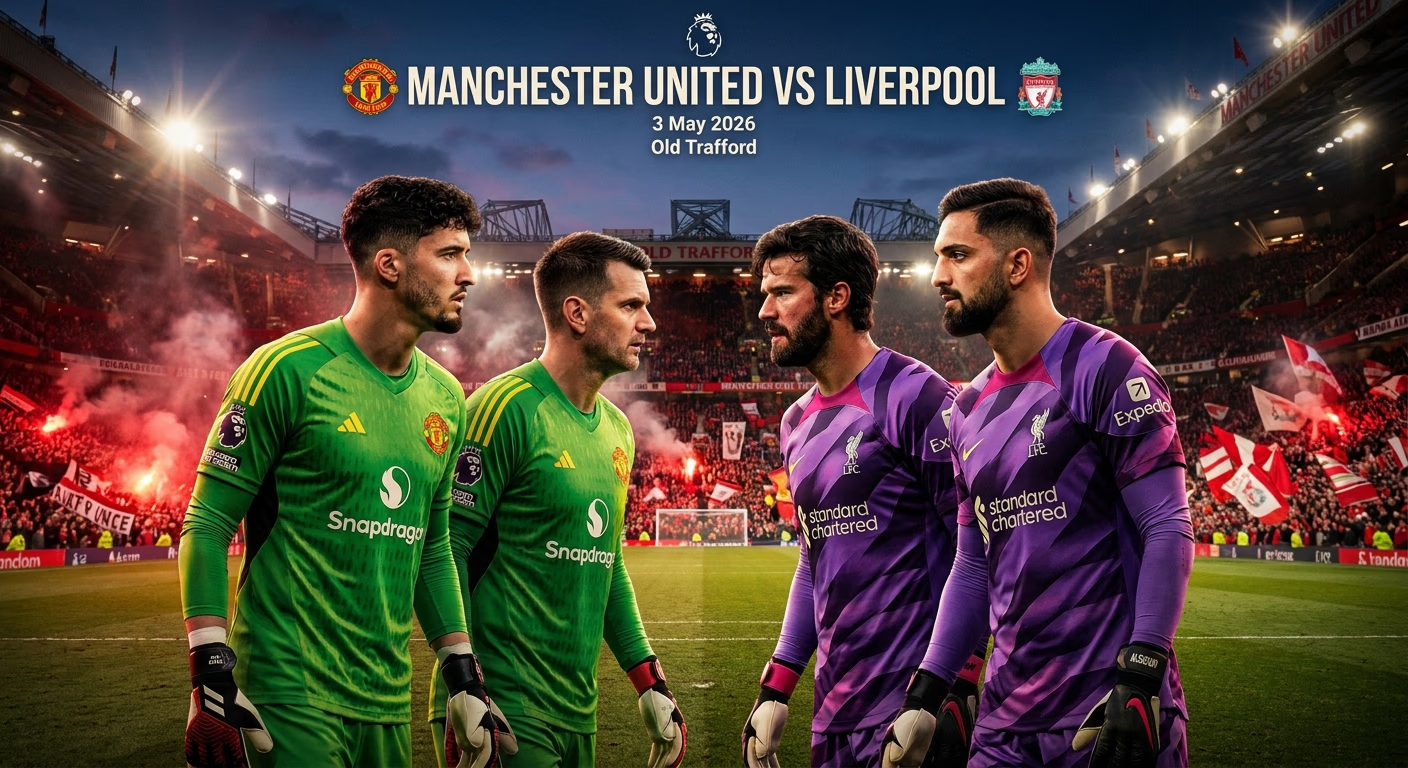


Old Trafford has seen this rivalry bend the league’s narrative before. Think back to the spring surges that defined the title races of 1996 or 2009, or the more recent duels in which the bragging rights felt inseparable from European qualification. On Sunday the stakes realign once more: Manchester United sit third on 61 points, Liverpool lurk three points back, and the Champions League’s looming reshuffle makes every inch of leverage matter. The question, then, is whether Ruben Amorim’s reinvigorated side can protect the momentum of a five-match run that has produced three victories, or if A. Slot can use this touchstone fixture to reassert Liverpool’s claim to the league’s top echelon.
What this suggests is less a simple points tussle than a referendum on two methods of reconstruction. Amorim has leaned into his preference for a back three that can spring into a front five when possession is secured, trusting the wing corridors to provide imbalance. That structure asks Old Trafford’s crowd to accept patience: United lure opponents into pressing traps before breaking lines, then rely on the front trio’s rotations to unnerve centre-backs. Slot, by contrast, has defaulted to a fluid 4-3-3 with inverted wide players stepping infield to overload central lanes, an echo of the work that made his reputation in Rotterdam. It is tempting to see their clash less as England’s most famous derby than as a debate on the modern orthodoxy of territorial control versus transitional incision.
United’s form column, WWLDW, points to a group rediscovering resilience, though the 46 goals conceded indicate fragility whenever counter-pressing falters. Amorim’s training ground emphasis has been on compactness between the lines, a bid to stop the midfield from fracturing under pressure. Without clear evidence yet that the defensive record has tightened, Old Trafford may have to accept a match decided by whoever lands the first significant punch in transition. Liverpool arrive with WWWLD in their last five and the knowledge that their away record, seven wins offset by seven defeats, reflects inconsistency rather than decline. Slot’s pressing resembled muscle memory in April’s victories but wavered in that recent draw, so the nuance will lie in how aggressively he instructs his full-backs to advance against United’s counter threat.
Statistics:
- Manchester United sit third on 61 points with a goal difference of +14.
- Liverpool occupy fourth on 58 points with a goal difference of +13.
- United have taken 11 wins from 17 home fixtures, scoring 33 and conceding 20.
- Liverpool have claimed seven wins from 17 away matches, scoring 25 and conceding 26.
The reality is that this fixture often rewards the side that absorbs noise without losing shape. Amorim may look to compress central space, allowing his forward line to spring whenever the visitors’ back four spreads wide. Slot must decide whether to press high at Old Trafford or to let the match breathe and bank on his midfield triangle’s ability to recycle possession. Either way, the tempo will hinge on those early exchanges: can United’s back line step into midfield without being caught, and will Liverpool’s front three coordinate their press well enough to force hurried clearances?
Elsewhere the wider European weekend carries its own subplots, from Lyon welcoming Rennes in Ligue 1’s late-season jostle to the relegation anxiety chronicled in Wolves against Sunderland. Yet everything on Sunday seems to orbit around Old Trafford’s drama: a top four place to consolidate, a cycle of dominance to revive, and two managers whose philosophies are still bedding in.
By Monday the table could show United pulling six points clear or Liverpool vaulting into third. In the broader context of a league now shaped by Arsenal’s front-running and Manchester City’s pursuit, the victor here positions themselves as the most credible challenger should either of those leaders stumble. All of which makes the whistle on Sunday feel less like the start of another meeting between old adversaries and more like the opening argument in how the Premier League intends to define its next era.