

Villa seize control of the Champions League door
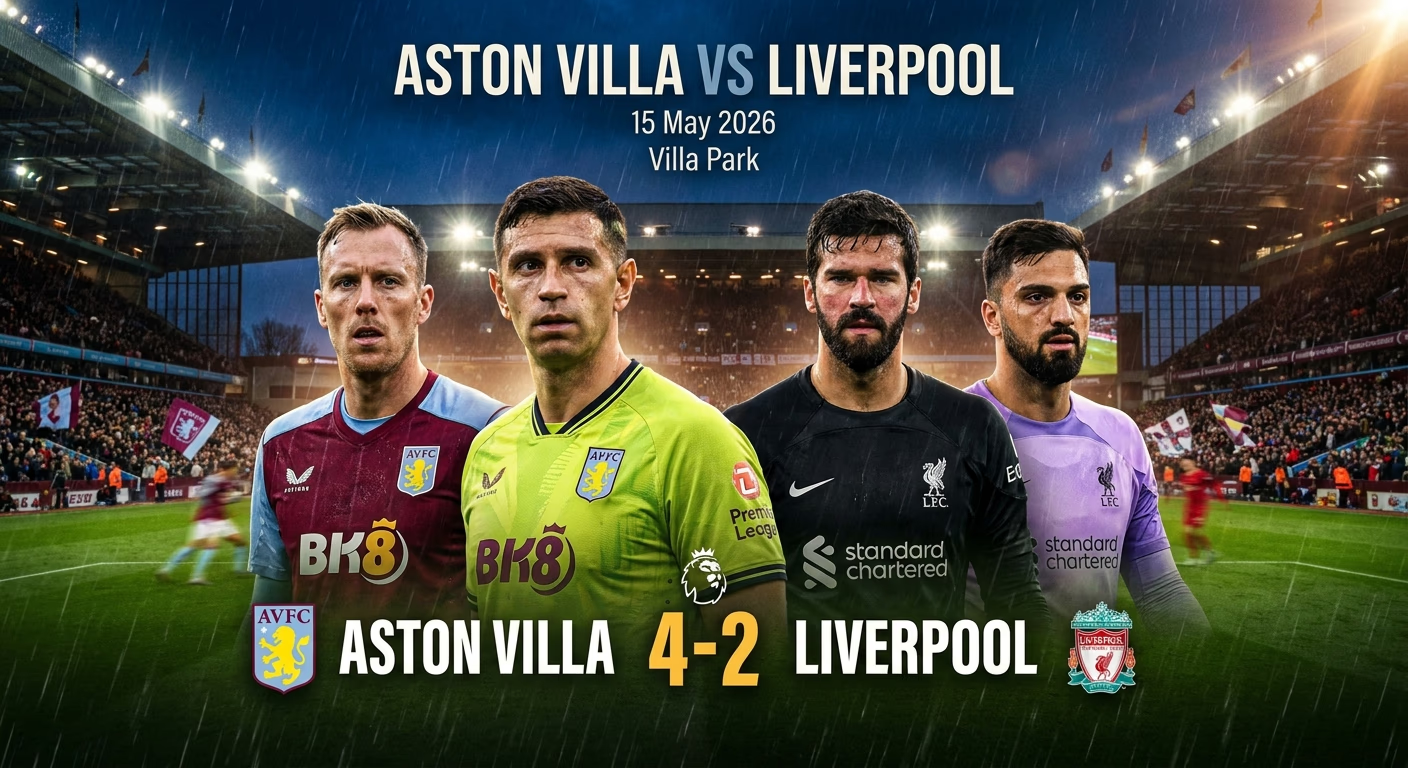
Villa Park has not witnessed a meeting this consequential since the autumn that produced that 7-2 fever dream, yet Friday night felt just as epochal. Aston Villa, marshalled by Unai Emery in his well-drilled 4-2-3-1, needed only avoid the familiar wobble that has haunted their springs. Instead they ripped through Liverpool and sealed their Champions League return with conviction, a 4-2 victory that owed everything to the cadence provided by Morgan Rogers and the relentless industry of Ollie Watkins.
The first act was a study in patience. Liverpool held 55 percent of the ball, Virgil van Dijk constant in possession as Arne Slot’s side moved it methodically, but Villa’s structure rarely buckled. After Matty Cash collected a yellow card for a 39th-minute lunge, Villa responded with clarity. Lucas Digne chose his overlap perfectly, and Rogers timed his run and finish in the 42nd minute to tilt the evening. Watkins, already booked for time wasting during first-half stoppage time, had set the tone with his ceaseless pressing; how many forwards can spend the interval on a caution and still control a game’s tempo?
Rogers and Watkins set the rhythm
Emery’s first adjustment at half-time brought Ross Barkley on for Victor Lindelöf, altering the press and giving Villa an extra carrier in midfield. For a brief spell it seemed risky: Dominik Szoboszlai finally exploited space between the lines, feeding van Dijk for an equaliser in the 52nd minute. The question, then, was whether Villa could steady themselves. Five minutes later they produced the answer. Rogers, now gliding in that half-space on the right, slid a precise pass into Watkins, who scored in the 57th minute to restore the lead and underline the understanding that has made Villa more than the sum of their parts.
Liverpool’s response was to turn to invention. Joe Gomez went into the book on 62 minutes, and Slot introduced Federico Chiesa and Florian Wirtz four minutes later, pushing Szoboszlai wider to chase overloads. Yet Watkins simply outpaced the tactical tweaks. His second goal in the 73rd minute completed a passage in which Pau Torres and Ezri Konsa repelled crosses while Barkley recycled loose balls. Mohamed Salah’s arrival a minute later brought menace but not control; by the time Emery replaced Emiliano Buendía with Ian Maatsen in the 85th minute, Villa were already managing the contest.
Late drama and the finishing touch
John McGinn, cautioned on 66 minutes, embodied Villa’s defiance. Still there in the 89th minute, he latched onto Watkins’ cutback to make it 4-1, seconds before Emery completed a pragmatic double switch. Douglas Luiz replaced Youri Tielemans and Jadon Sancho relieved his captain in the 90th minute, allowing Villa to reset before van Dijk’s second goal, again supplied by Szoboszlai, trimmed the margin. It was the perfect snapshot of Villa’s maturity: celebrate, reorganise, and finish the job.
Key statistics
- Shots on target: Aston Villa 9, Liverpool 5
- Expected goals: Aston Villa 1.91, Liverpool 1.52
- Possession: Aston Villa 45 percent, Liverpool 55 percent
- Yellow cards: Aston Villa 3 (Cash 39, Watkins 45+3, McGinn 66), Liverpool 1 (Gomez 62)
What it means
In the broader context of Emery’s tenure, this was the night the project felt inevitable. Rogers, once a prospect, now looks central to Villa’s attacking orthodoxy, and Watkins’ blend of goals and assists has become the club’s signature. Villa can travel into the final weekend with Champions League status secured; their 62 points cannot be matched by sixth-placed Bournemouth, who can only reach 61. Slot, meanwhile, has to coax a sharper defensive structure from Liverpool in short order, because conceding four in Birmingham will not wash when European qualification still hangs in the balance. The margins will be just as fine in that last domestic fixture, and Liverpool must learn quickly or face a summer of uncomfortable questions.